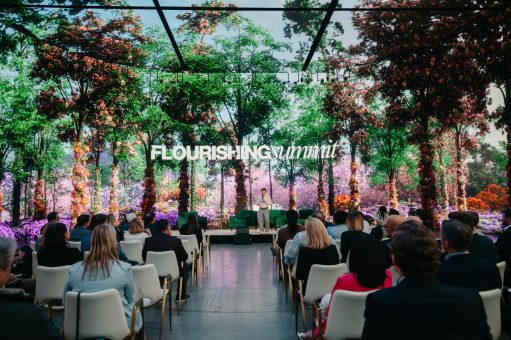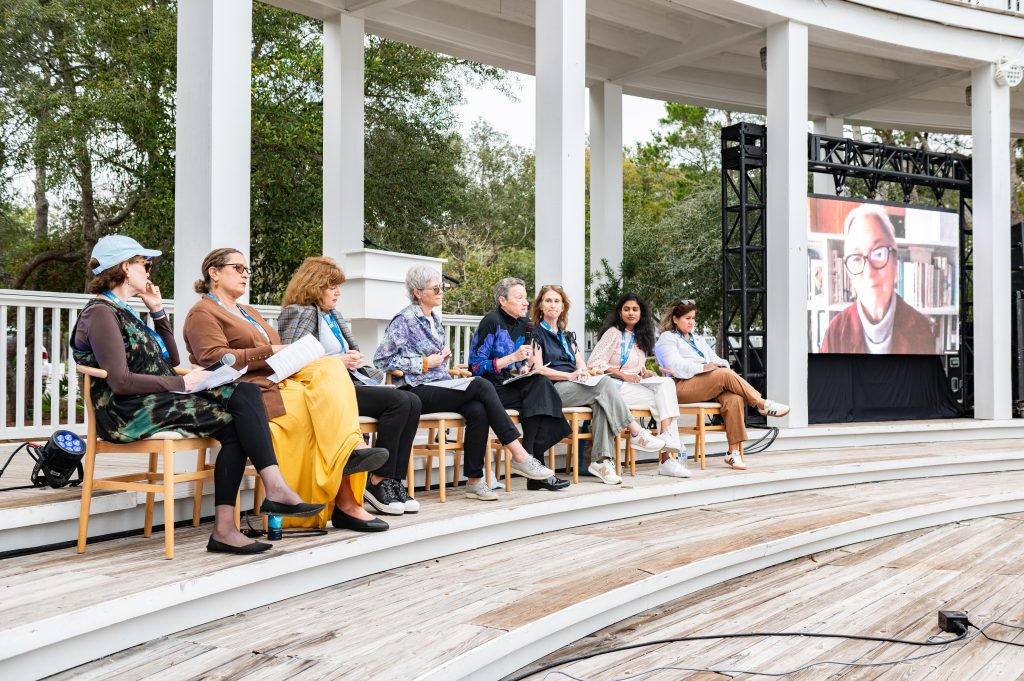
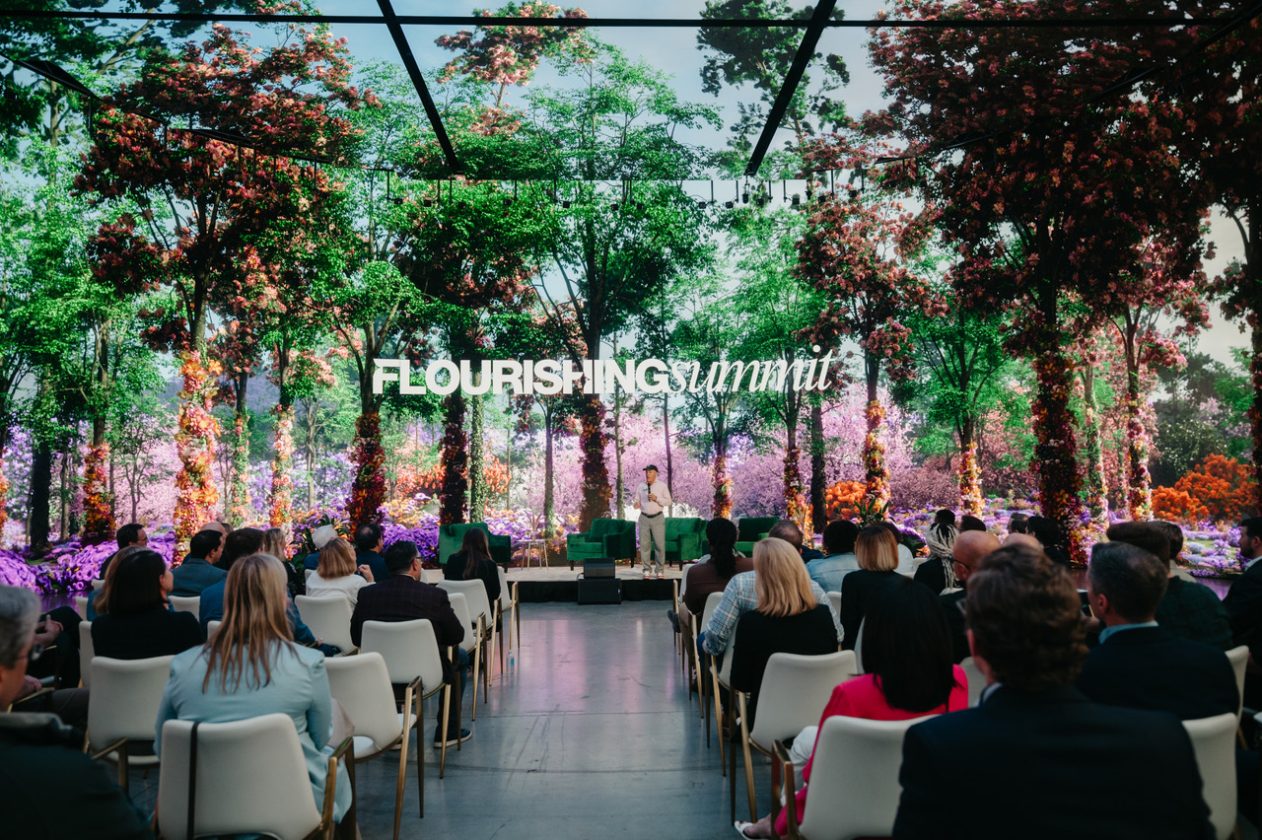
Audience attending Flourishing Summit keynote in immersive floral, nature-inspired event space.

The Trilith Foundation’s Flourishing Summit

Program fosters collaboration through a relationship-building environment

By Christy Milliken

Seaside Institute, Executive Director

In today’s rapidly changing world, the pursuit of human flourishing has become more than a philosophical ideal — it is a practical necessity for resilient communities and sustainable leadership. Recognizing this, a remarkable gathering was orchestrated to bring together visionaries from a tapestry of disciplines and experiences, all united by a common ambition: to cultivate environments where individuals and collectives not only succeed but truly thrive.

I had the privilege of being among a group of leaders this past summer for a Flourishing Summit at Trilith Studios in the Town at Trilith, presented by the Trilith Foundation. The weekend was carefully curated for leaders and creatives with diverse backgrounds for two days of connectivity, inspiration and wellness. These are core values we cultivate at the Seaside Institute as we inspire communities where people do not just live, but thrive. We all strive as leaders to pour into our family, job, mission and community, etc. and often forget to fill our own cup in the process. The two-day event brought together like-minded individuals to reflect on global flourishing and discuss ways to share this message locally.

Elizabeth Dixon, executive director of the Trilith Foundation, envisioned the program to inspire and restore those that attended while making new connections in a relationship building environment that will hopefully foster collaboration. 

The summit was an honest and authentic space that introduced the concept of human flourishing, allowing people to engage with it. Leveraging global research, which originated in partnership with the Global Flourishing Study team at Harvard University and Baylor University, and immersive experiences, The team at Trilith provided an intentional environment for influential storytellers, academics and culture-makers to explore how integrating flourishing concepts could enhance and multiply the impact of our work forward.

As the sun cast its golden glow over the creative heart of Trilith, participants immersed themselves in an atmosphere both invigorating and restorative. Workshops and roundtable dialogues encouraged attendees to peel back the layers of conventional leadership, delving into the intersection of well-being, creativity and social responsibility. The summit followed a relaxed pace, allowing time for listening, laughter and reflection, emphasizing holistic well-being.

Whether sharing insights over artisan coffee or engaging in reflective exercises amid the cinematic soundstages, every interaction seemed charged with possibility. Thought leaders, community builders and innovators shared transformative stories, illuminating how the principles of human flourishing could be translated into tangible actions that ripple from the individual to the collective. The spirit of the gathering was not one of competition, but of co-creation — a space where vulnerability and vision could meet, forging new alliances and sparking new ideas to elevate the quality of life for all.

We began the weekend with tours of Trilith Studios, formerly Pinewood Studios. The multiple production studios are state-of-the-art facilities where filmmaking and motion pictures thrive. The latest box office hit filmed on site was “Superman.” Our summit also took place in one of the production studios for a more immersive experience.

Dan Cathy, founder of Chick-Fil-A and Rob Parker, president and CEO of Trilith Development, led a tour of the mixed-use New Urbanism neighborhood of Trilith and showed why many flock here to live, work and play.

During the summit, we heard from an eclectic group of leaders at Harvard, Baylor, Physicians, as well as Chick Fil-A founders and leaders, Grammy-winning musicians, pro sports professionals, and other leaders who presented the Global Flourishing Study by Gallup.  

The Gallup Global Flourishing Study explores six domains valued across countries and cultures. The Secure Flourishing Index (SFI) measures these through targeted survey items, with five domains pursued for their own sake and financial stability providing the foundation. When financial stability is omitted, the measure becomes the Flourishing Index (FI), while contextual factors help understand environments where flourishing thrives in categories such as happiness and life satisfaction, mental and physical health, meaning and purpose, character and value, close social relationships, financial and material stability, and religion and spirituality. When cultivating a community, these factors are important to human flourishing. While we design physical environments, we also need to study the community’s quality of life.

The summit encouraged leaders to not only connect, but to rest and reflect. We had yoga and massage services available each morning. And we had a fantastic engaging meal that provoked meaningful conversations from prompt cards placed on our table.

A new sense of purpose and renewal left with each leader, so we could continue to inspire vision forward and the motto of the Trilith Foundation which is “Be Well, Do Good – Together.”

“A good shepherd smells like his sheep/flock.”

    ~Dan Cathy, vision officer/founder of the Town at Trilith, Trilith Studios, Trilith Foundation, Trilith Institute, Trilith Live and Chick-Fil-A.

 

Three metallic keys featuring "Seaside Prize" inscription, each shown from different angles, set against black background.

Presenting the 32nd SEASIDE Prize™ Celebration


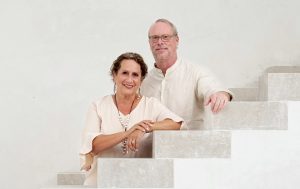
SEASIDE Institute™ Announces Marieanne Khoury-Vogt and Erik Vogt as the 2026 Seaside Prize Recipients

(Seaside, Fla.) – The SEASIDE Institute™ is thrilled to announce the recipients of the prestigious 2026 SEASIDE Prize™. The prize, which is awarded annually, celebrates individuals who have made significant contributions to the fields of architecture, urban planning, and community development.

On this momentous occasion of the Seaside Prize, the Seaside Institute is honored to bestow this recognition upon two distinguished individuals: Marieanne Khoury-Vogt and Erik Vogt. The celebration will take place the weekend of February 6 through February 8, 2026, with a variety of events and symposia focused on resiliency, sustainability, and legacy.

Khoury & Vogt Architects (KVA) was formed in 2001 in Miami by Erik Vogt and Marieanne Khoury as a practice in architecture, urban design, and town planning. Erik received his Bachelor of Architecture from the University of Miami and Master of Architecture from Yale University. Marieanne received a Bachelor of Architecture from the University of Wisconsin (after studying for 3 years at L’Ecole Spéciale d’Architecture in Paris, France) and has a Master of Architecture and Master of Urban Planning from the University of Wisconsin at Milwaukee. Both are licensed architects working throughout the country.

The practice, currently based in Alys Beach, Florida, engages projects in a variety of scales, programs, and locales. Each is strongly rooted in enduring types and forms that have developed over time to serve both the individual inhabitant at the scale of the building and shape the individual building at the scale of the city. This grounding in typological tradition allows for an exploration of architectural character and language that, while deploying the principles of classical composition, offers a synthesis of modern and vernacular styles, often inflected by the influence of the tropics and Mediterranean. In all cases, the work strives to partake in equal parts both tradition and invention and to instill in the inhabitant a sense of comfort and delight.

Their work has received numerous awards and accolades, and their work has been extensively published. In 2023, they were awarded the prestigious annual Arthur Ross Award for their body of work by the ICAA (The Institute of Classical Architecture and Art) that recognizes excellence in the classical tradition, and in 2024, Marieanne was awarded the annual 2024 Barranco Award by the Urban Guild for her work as Town Architect in Alys Beach.

The Seaside Prize is a testament to the tremendous impact Marieanne Khoury-Vogt and Erik Vogt have had on the built environment. Their work has inspired fellow architects, urban designers, developers, and community leaders to value the role of architectural design in both the individual building and urban placemaking and their collective contribution to the beauty and sustainability of the larger community.

Marieanne Khoury-Vogt and Erik Vogt will be honored at the awards ceremony on February 7, 2026, by Seaside, Florida, founder Robert and Daryl Davis. The ceremony will be hosted at The Chapel at Seaside, and it promises to be an evening of celebration, reflection and inspiration.

For more information about the Seaside Prize and the Seaside Institute, please visit our website at SeasideInstitute.org. Registration opens for the 2026 Seaside Prize on October 1st, 2025.

About the SEASIDE Prize™:

The Seaside Prize is an annual award presented by the Seaside Institute to individuals who have made significant contributions to the fields of architecture, urban planning, and community development. The recipients are selected based on their exceptional achievements, commitment to design excellence, and their positive impact on communities around the world.

About the SEASIDE Insitute™:

The Seaside Institute was founded in 1982. It is a non-profit organization that has been dedicated to advancing the ideas of community, education, and design for 42 years. Through research, programs, and events, the institute strives to create sustainable, resilient, and livable communities. With its roots in the iconic town of Seaside, Florida, the Seaside Institute serves as a collaborative hub for architects, urban planners, and community leaders.

About SEASIDE®:

Seaside, Florida, was founded in 1981 by Robert and Daryl Davis. Later, the architectural influence of Andrés Duany and Elizabeth Plater-Zyberk explored the ideas of traditional town design before sprawl became the new normal. Seaside is considered the birthplace of New Urbanism through its influence and radical ideas to minimize the trending sprawl and go back to the roots of walkable, sustainable, mixed-use town planning. Seaside soon became a place people sought out to experience as a retreat. Other towns and communities worldwide were influenced by the core principles that Seaside embodies. Seaside has become a movement, not just a location, as its rich roots and history make it truly a unique pioneer to all who study New Urbanism principles.

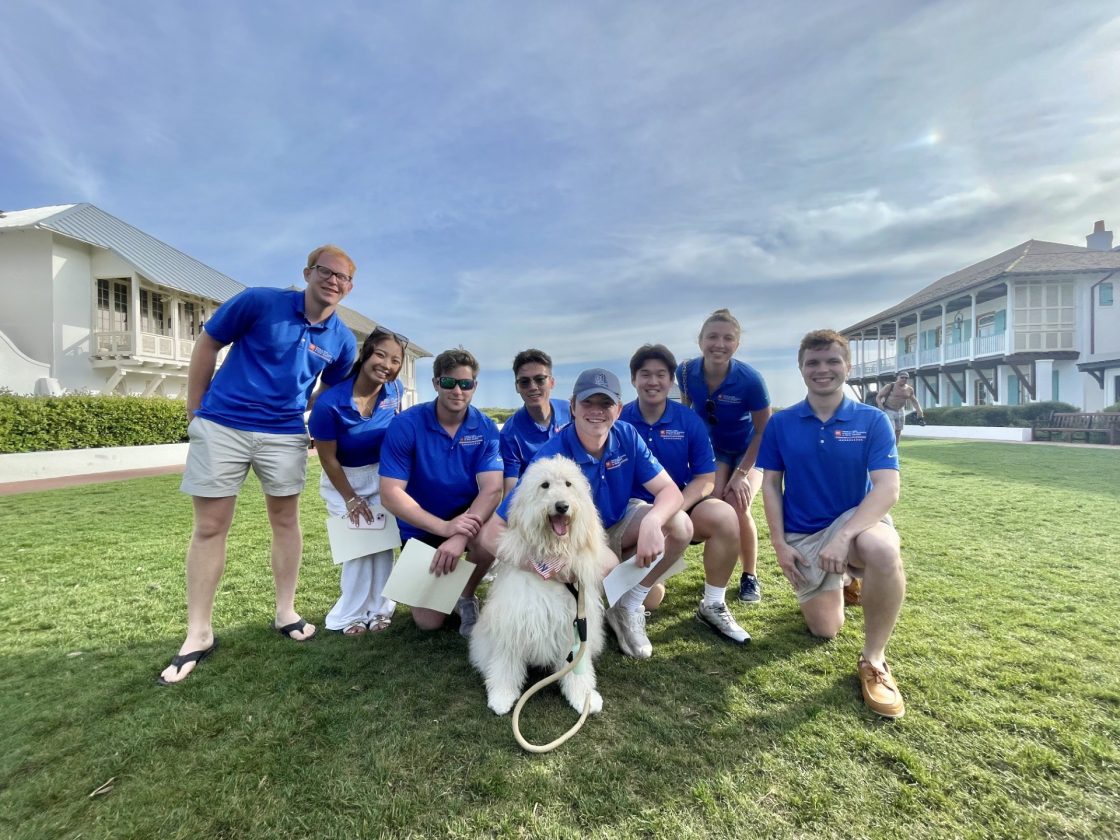
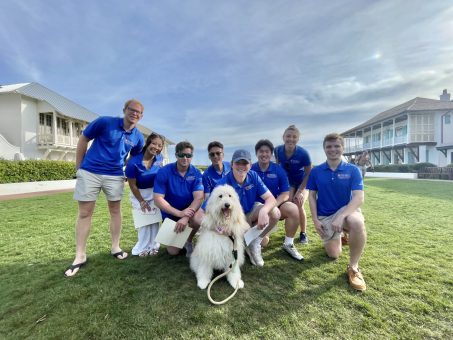
A group of people in matching blue shirts pose with a fluffy white dog on green lawn outdoors.

Education and Community

The SEASIDE Institute™ hosts University of Florida student tours

By Christy Milliken, 

Executive Director, SEASIDE Institute™

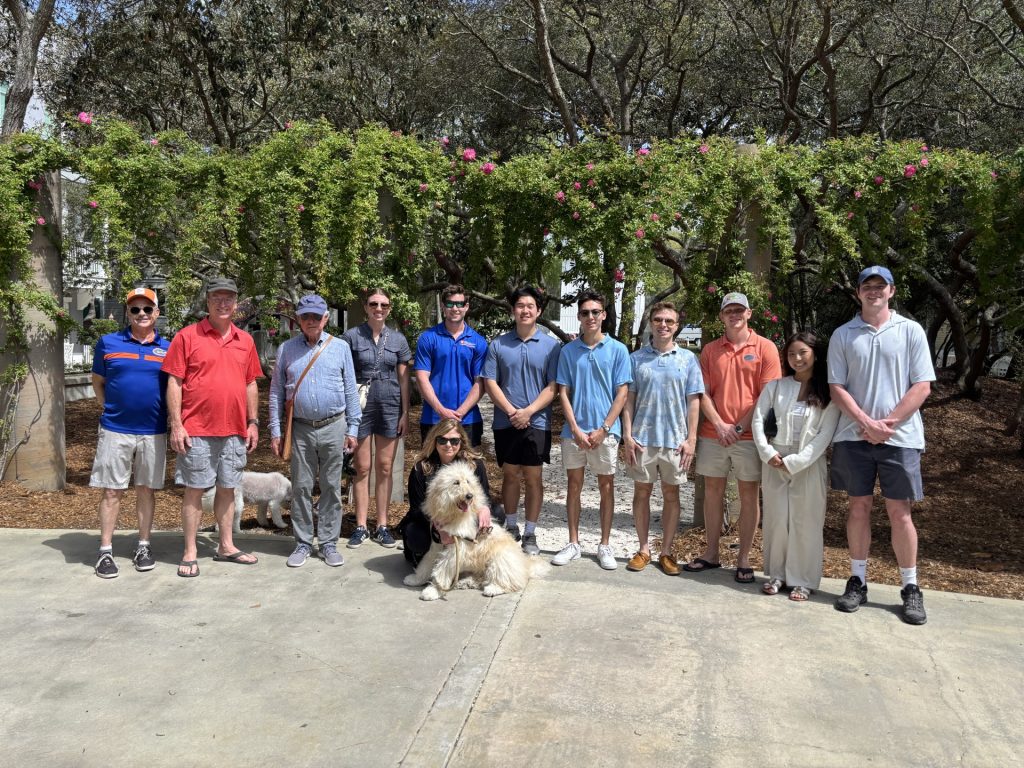
In an inspiring celebration of education and community planning, the SEASIDE Institute™ welcomed students from the University of Florida Master of Science in Real Estate program to partake in an immersive experience across the scenic locations of SEASIDE®, Rosemary Beach and Alys Beach on April 4. The program, led by esteemed faculty member Dr. Steve Martin, Clinical Assistant Professor of Finance, Insurance, and Real Estate Development at Warrington College of Business, provided a unique opportunity to explore the history and innovations of the DPZ CoDesign master-planned communities.

Spanning two days in the picturesque region of South Walton, students delved into the intricacies of real estate development, architectural brilliance, retail strategies, sustainability efforts, and the success stories of mixed-use neighborhood planning. Through this holistic approach, the tours emphasized the importance of community resilience and intentional design in fostering thriving urban environments.

The Alys Beach Experience

The first stop of the enlightening tour was Alys Beach, where Diana Lane, Director of Public Relations, set the stage with an extensive overview of the town’s intentional design elements. From its striking architectural forms to its commitment to sustainability, Alys Beach served as a prime example of forward-thinking urban planning. Students were encouraged to examine how meticulous design can enhance both aesthetic appeal and functional utility, creating a harmonious balance between natural beauty, the arts, and human development.

Rosemary Beach: Architecture and Community

In Rosemary Beach, the exploration continued with a guided tour led by Larry Davis of Seaside Community Realty and Bret Azzarelli, the Town Architect for Rosemary Beach. This segment of the tour highlighted the seamless integration of architecture and community, showcasing how thoughtful planning contributes to the vibrancy and cohesion of a neighborhood. Students gained valuable insights into the design principles that make Rosemary Beach a standout example of new urbanism and mixed-use development.

Seaside: The Birthplace of New Urbanism

The culmination of the tour took place in SEASIDE®, where Robert Davis, the visionary Co-Founder of Seaside, provided an in-depth look at the origins of new urbanism. Founded in 1981, SEASIDE® was designed to challenge conventional suburban sprawl and promote walkable, sustainable communities. Davis shared the town’s journey from concept to reality, providing students with a firsthand glimpse into the transformative power of intentional community planning.

Large family group with two dogs posing on sunny path beneath flowering green vine-covered trellis.

Reflections on Holistic Development

Throughout the tours, the students explored the practical application of mixed-use neighborhood planning — a cornerstone of DPZ CoDesign’s philosophy. By integrating residential, commercial and recreational spaces, these master-planned communities demonstrate how thoughtful design enhances the quality of life for residents while fostering economic and environmental sustainability.

Students were inspired by the stories of success and resilience embedded in the histories of these towns, as they reflected on how the lessons learned could be applied to future real estate and urban development projects. The tours also underscored the importance of collaboration among developers, architects, and planners to achieve visionary goals.

A Lasting Impact

The SEASIDE Institute’s efforts to host these tours highlight its commitment to education and innovation. By bringing together the next generation of real estate professionals with luminaries in the field, the Institute continues to serve as a beacon for thoughtful community planning and sustainable development.

As the students returned to the University of Florida – Warrington College of Business, they carried with them not only a wealth of knowledge but also a deep appreciation for the power of intentional design and holistic planning. It is initiatives like these that pave the way for a brighter, more sustainable future in urban development.

The SEASIDE Institute™ once again proves that education, collaboration, and visionary planning are the cornerstones of building resilient and thriving communities. The Seaside Institute is planning to work together with the UF Warrington college program this Fall on a symposium discussion that focuses on the story of Daryl Davis, Co-Founder of Seaside.

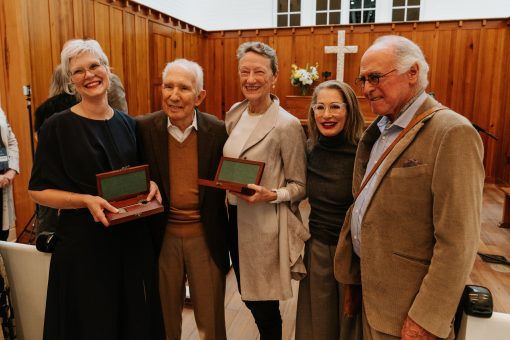
Five smiling adults in formal attire pose indoors holding award boxes in a wooden-paneled room.

Prize Weekend

The SEASIDE Institute™ hosts leaders in New Urbanism

By Christy Milliken, Executive Director, The SEASIDE Institute™

The SEASIDE Institute™ celebrated the 31st SEASIDE Prize™ Weekend by honoring Ellen Dunham-Jones and June Williamson. The theme of the weekend was Retrofitting Suburbia.

The Seaside Prize is an award that recognizes individuals or organizations for contributions to the development of walkable, sustainable communities. Established in Seaside, Fla., through the Seaside Institute, the prize typically highlights projects that embody the values of community, sustainability and design excellence. The core values of prize recipients embody the mission and tenants of the Seaside Institute in the town that began the New Urbanism movement forty-four years ago. Prize recipients are nominated by the Seaside Institute Board of Fellows and final votes are decided by the Seaside Institute Board of Governors.

Thursday, Feb. 6, sponsors and VIPs enjoyed a red-carpet welcome with an evening at SOWAL House in Rosemary Beach for an Escape to Create art show curated by Anne Hunter Galleries and a music experience with 2011 Escape to Create artists, Vanessa Olivarez and Elizabeth Elkins of Granville Automatic. The evening included a little tambourine back up featuring Robert Davis on one song. 

The weekend kicked off on Friday, Feb. 7, at sunset with an outdoor soirée reception at 87 Central, a Chef Jim Shirley establishment that included paella, charcuterie, seafood, olive tapenade and goat cheese, mini brisket sliders, mini tuna poke and desserts. The C-Bar, also a Chef Jim Shirley establishment, created a specialty cocktail, “Pinky and the Brain” to celebrate the female winners this year. This was a perfect way to welcome Prize attendees to experience the town of Seaside in the heart of Central Square. When the reception came to an end, to ensure no food waste, the left-over paella was donated to the South Walton Fire Department.

The evening reception was followed by a welcome at the Seaside Lyceum from Daryl Rose Davis, founder of The SEASIDE Style®, co-founder of Seaside, and the Seaside Institute. Introductions were delivered by Lisa Burwell, Chair of the Seaside Institute and Christy Milliken, Executive Director of the Seaside Institute. Prize recipients, Ellen Dunham–Jones, Professor, Georgia Institute of Technology and June Williamson, Professor at The City College of New York, delivered a keynote lecture titled, “Adventures in Retrofitting Suburbia.” The talk delivered a light-hearted look at the history of their work together and an in-depth look at the need to consider the repair of sprawl through the methods of the suburban retrofit work they are known for.

The Signature Seaside Saturday Symposium began with coffee provided by Amavida Coffee Roasters and a breakfast set up by Black Bear Bread Co. Before we kicked off the morning symposium speaker lineup, we took a moment to honor and remember 2023 Prize recipient, Donald Shoup, as we just learned of his passing that morning.

The first lecture of the morning was delivered by Galina Tachieva and Marina Khoury of DPZ CoDesign as they focused on the Walton County Comprehensive Plan (PlanForWalton2040.com). This talk highlighted varying zones, land conservation, land use and mixed-use development suggestions while also looking for ways to repair sprawl, retrofit suburban areas and connect communities.

Our second lecture was delivered by Becky Nicolaides, Suburban Historian and Author, and Rachel Heiman, The New School. Becky’s family lost their home and community in the Palisades fires in California just weeks before the Seaside Prize weekend. This conversation was raw with emotion and engaged the audience in discussion regarding disaster recovery, climate resilience, how to honor the lost history and how to tackle the overwhelming task of rebuilding an entire community from the ashes.

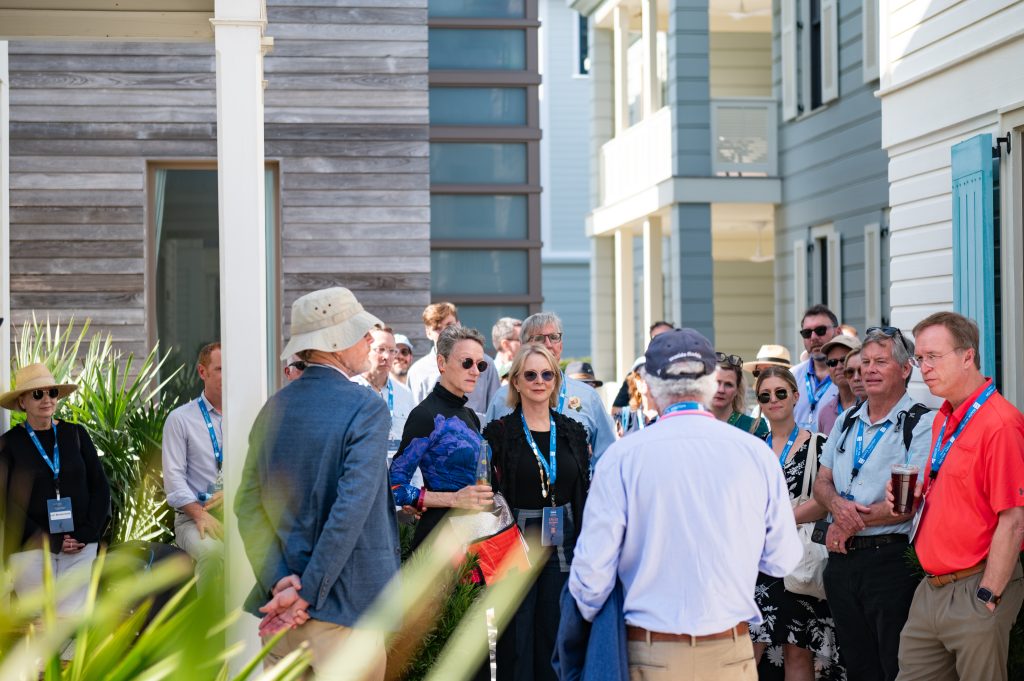
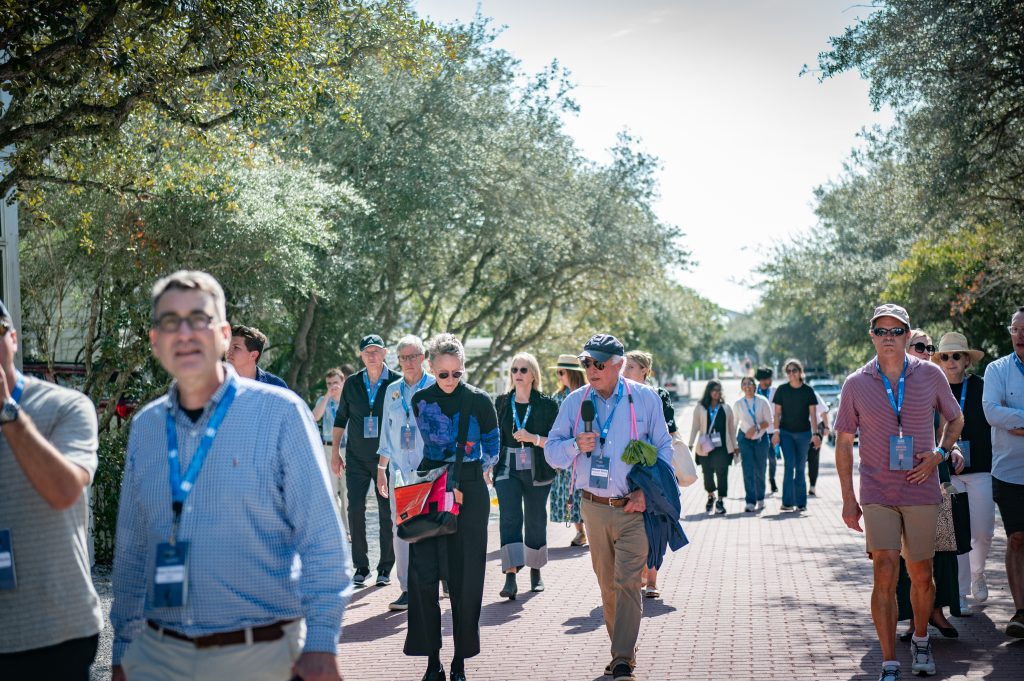
Saturday continued with a walking tour of Seaside led by Robert Davis, Micah Davis, and Dhiru Thadani. We also had optional tours with our partners at the Cultural Arts Alliance of Walton County for their Tour of Homes. We resumed afternoon symposia with Dolores Hayden, Yale, and Emily Talen, University of Chicago. This conversation was followed by a closing panel that included all the speakers and was moderated by this year’s prize recipients, Dunham-Jones and Williamson. All panel speakers signed books at a signing hosted by Sundog Books.

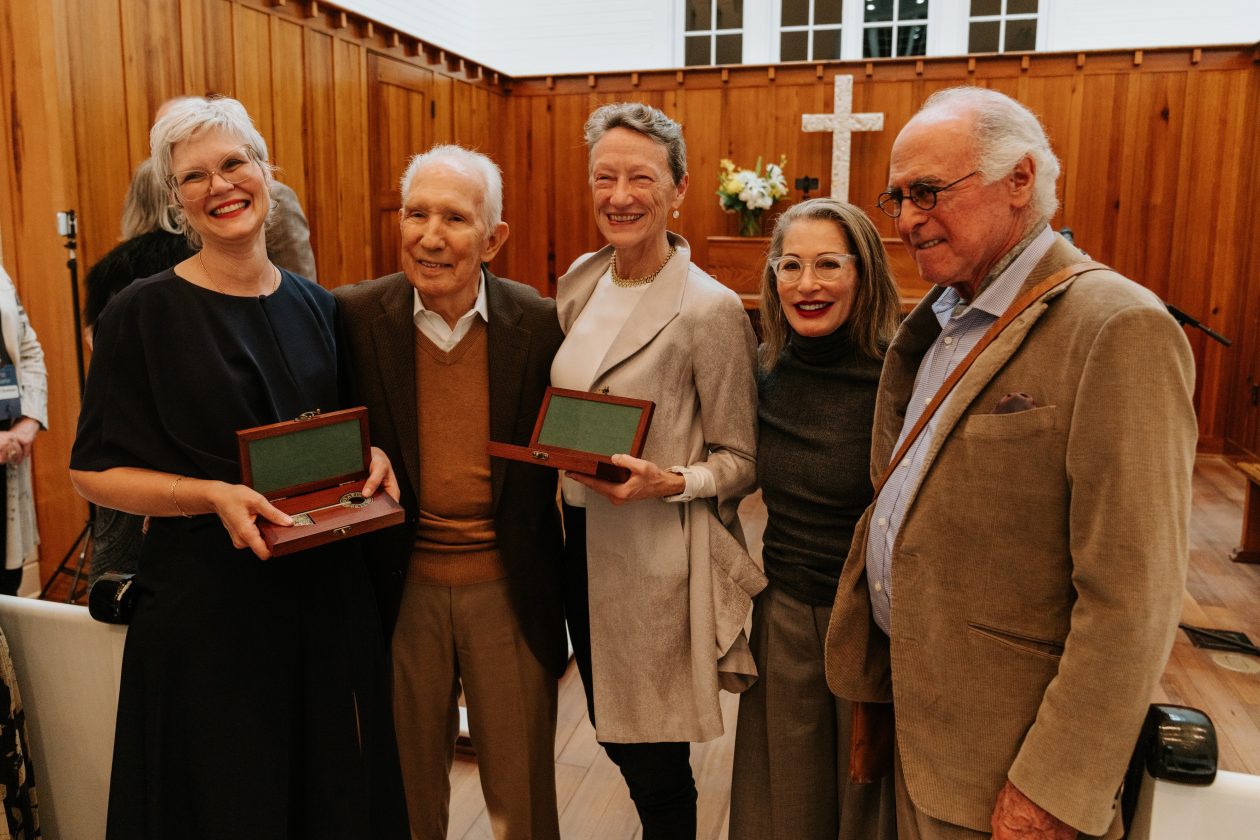
The award ceremony was commemorated in The Chapel at Seaside, designed by Scott Merrill with millwork by E.F. San Juan. The interfaith chapel was also accepted into the permanent Historic archive at the Library of Congress in 2004. Reminding us that newer architecture can be considered as a historical landmark. The key ceremony offered inspirational words by Devaki Kesh, Principle U.S., and Veronica Rivas-Plaza, Street Plans. They shared heartfelt experiences about their mentors and prize recipients. Robert and Daryl Rose Davis awarded the “key to the town” to Dunham-Jones and Williamson. 

The Prize key was designed by Dhiru Thadani and cast by Manish Waghdhare. The key is housed in a mahogany box handcrafted by Edward F. San Juan. The evening flowed into the night for the Awards Dinner at Bud & Alley’s Waterfront Dining where attendees were able to mingle and engage with prize winners. The tablescapes were elegantly curated by Rose & Co. Flowers.

We wrapped up our Prize weekend on Sunday with a Sustainable Coffee Tasting Experience: Brewed Awakenings by Amavida Coffee Roasters, breakfast by Black Bear Bread Co. and a Talk of the Towns – Green by Design by Senen Antonio, DPZ CoDesign. The talk was followed by various tours, including a tour in Rosemary Beach led by Larry Davis, Seaside Community Realty, and Bret Azzarelli, RB Town Architect, and a tour in Alys Beach led by Marieanne Khoury-Vogt, KVA. An inaugural bike tour to Grayton Beach was introduced and sponsored in-kind by Yolo Board and Bikes and led by Micah Davis and Christy Milliken. Hosted with a talk about the history and growth of Grayton Beach by Billy Buzzett. Examples of tactical urbanism, recovery of public spaces for people, and pedestrian priority was a primary exploration. The bike tour included refreshments (Pedaler’s Punch) by Beach Better Co., a beachside concierge company and sponsored in-kind by Half Shell Vodka, a locally crafted vodka in a 94% sustainable cardboard bottle distilled at Distillery 98.

The night ended with a retrospective art event at Anne Hunter Galleries featuring Alex Name, Patricia Anderson, and Dave King where a portion of the proceeds benefit the Seaside Institute.

The key to a great community is the people that occupy it. This is why the mission at the Seaside Institute remains steadfast on advocating spaces that are designed for people.

Congratulations to Ellen and June, the newest members of the Seaside Institute Board of Fellows.

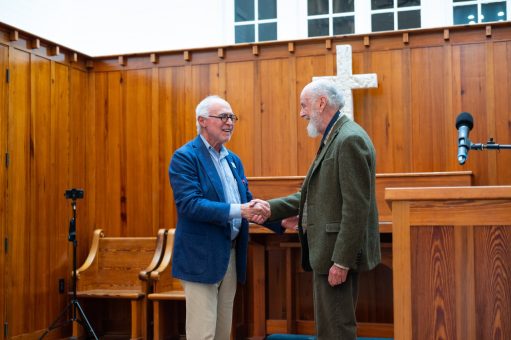
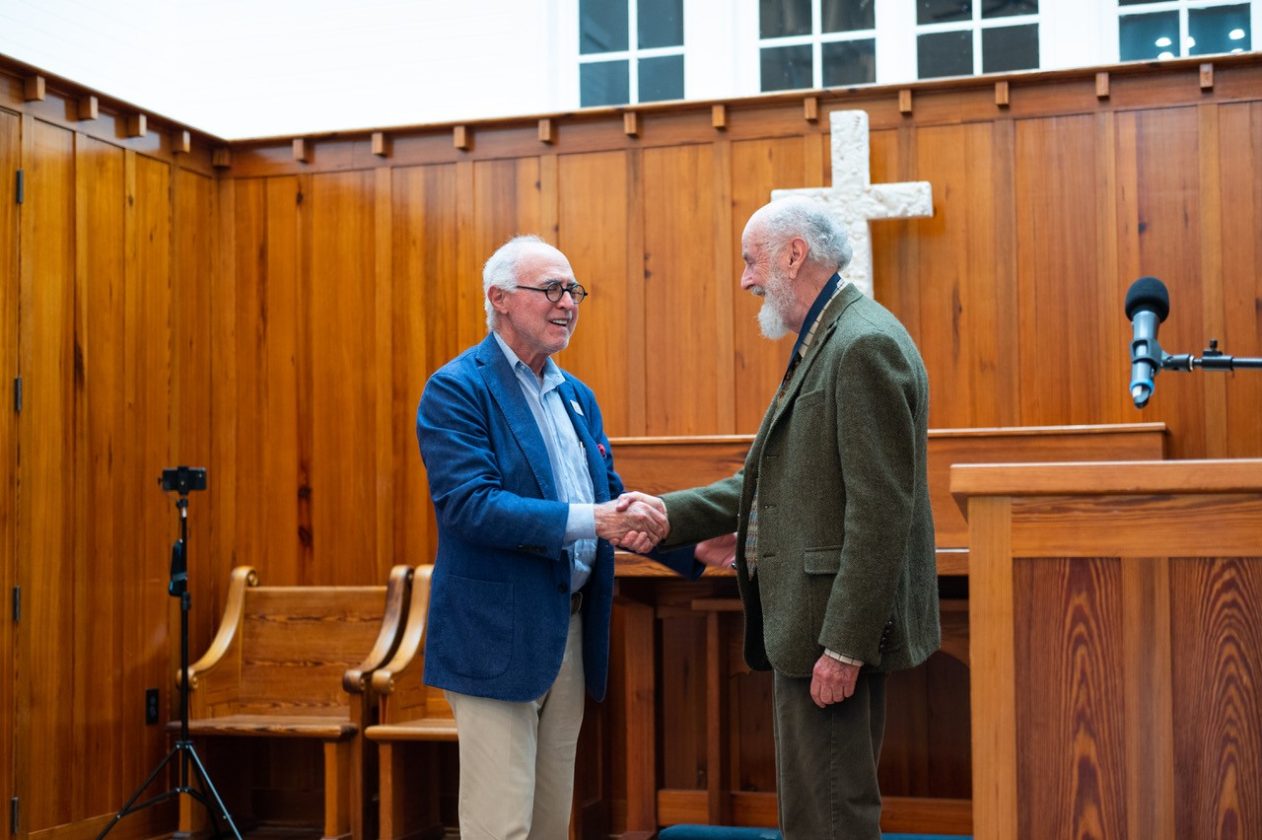
Two elderly men smiling and shaking hands in a wooden chapel with a cross in the background.

Honoring Donald Shoup’s Legacy

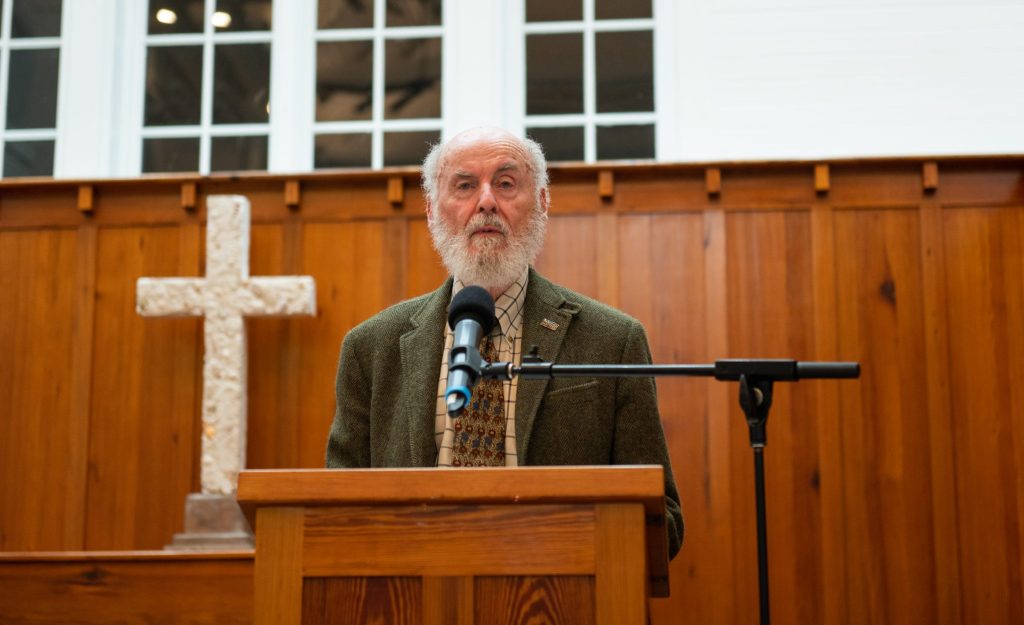
An elderly man stands at a wooden lectern speaking into a microphone inside a church, with a cross behind him.

A dedication to Donald Shoup (1938-2025)

One of the first projects assigned to me in my career with Seaside was parking management. As you can imagine, if you have visited the 30A and Seaside area during peak season, you can attest that this is no easy undertaking. I remember when my general manager offered me a book to help me learn about parking management through paid parking — The High Cost of Free Parking, Donald Shoup’s landmark publication. She explained it was Robert Davis’ “parking bible.” For a parking greenhorn like myself, reading this in the beginning was a very good sleep aid. But the more I studied Shoup’s work and the tangible relationships between managed parking, congestion improvement, and creating a constant supply, I began to see Shoup as he really was — a master in a field that, essentially, he alone was leading.

Shoup was awarded the Seaside Prize in 2023 for his radical methods of rethinking parking policies and management. I had the immense pleasure of meeting him that year, and I recall being terrified that a professional like him was reviewing our parking management model. However, my fear was completely unfounded. When Shoup entered the conference room, despite the monumental importance of the subject, his demeanor was playful — almost giddy in an infectious way. Despite his reputation preceding him, he didn’t seem to take himself too seriously. 

Donald Shoup was a true leader and visionary in the realm of parking management, and as a good leader tends to do, he gained quite a sizable following nationally and internationally. These “Shoupistas” are a collective of young innovators seeking to build upon Shoup’s work and change the world of parking, traffic congestion, energy reduction, and the way we view the built environment. “Shoup Dogg,” as he was sometimes jokingly referred to by his followers, inspired people to improve the quality of our daily interactions with the community on many levels.

Parking is the most important aspect of a business. It is the first thing people experience when they arrive and the last experience when they depart. A bad experience can set a negative tone for the day, even if the visit in between was magical. Shoup dedicated his life in academia to better improving those important aspects that people pay so little attention to — but, as he believed wholeheartedly, parking matters.

Shoup will be remembered by countless individuals, as his work laid a foundation, and his words will continue to inspire future generations to carry the torch of his legacy.

Jeremy Barnes

Executive Director of Operations – Seaside

Close-up of Seaside Prize award key displayed in an open wooden box with green interior.

Stellar Speaker Lineup – SEASIDE Institute™ announces speaker lineup for SEASIDE Prize™ weekend

By Kimberly Stanley, 

Marketing & Development Coordinator

SEASIDE Institute™ has announced speakers for the 2025 SEASIDE Prize™. These dynamic individuals will join us Feb. 7-9, 2025, as we honor the career achievements of this year’s recipients, Ellen Dunham-Jones and June Williamson.

Dolores Hayden

Dolores Hayden is professor emerita of architecture, urbanism, and American studies at Yale University. A renowned scholar of the history of the American urban landscape and the politics of place, her works have been translated into over a dozen languages.

She is the author of many award-winning books including Building Suburbia: Green Fields and Urban Growth, 1820-2000 (Pantheon, 2003), A Field Guide to Sprawl (W.W. Norton, 2004), and Redesigning the American Dream: Gender, Housing, and Family Life (W.W. Norton, 2002), titles that have been featured in The New York TimesThe Wall Street JournalThe Boston GlobeCNN and The Diane Rehm Show. Her earlier works include Seven American Utopias: The Architecture of Communitarian Socialism, 1790-1975 (MIT Press, 1976) and The Grand Domestic Revolution: A History of Feminist Designs for American Homes, Neighborhoods, and Cities (MIT Press, 1981).

 A former president of the Urban History Association, and a Fellow of the Society of Architectural Historians, Hayden is the recipient of the Radcliffe Graduate Medal for outstanding scholarship, an American Library Association Notable Book Award, two awards for Excellence in Design Research from the National Endowment for the Arts, the Paul Davidoff Award for an outstanding book in urban planning, the Donald Award and the Oculus Award for feminist scholarship. She has held fellowships from the Guggenheim Foundation, the Rockefeller Foundation, the American Council of Learned Societies, the Radcliffe Institute, the NEH, the NEA, and the Center for Advanced Study in the Behavioral Sciences at Stanford. 

Devaki Kesh

Devaki Kesh is an architect and urban designer who is passionate about vernacular and local architecture, public space design, conservation, and form-based codes. She believes in three opportunities through urban design – social bonding, cultural expression, and ecological sensitivity. 

Kesh is an Associate at Principle, an award-winning planning, urban design, and development firm committed to creating authentic places for human-oriented environments. She received a master’s degree in urban design from Georgia Tech and a bachelor’s degree in architecture from RV College of Architecture. In her free time, she enjoys making art, reading books, and being in nature.

Marina Khoury

Marina Khoury is an expert in sustainable urban redevelopment, regional and master planning, transit-oriented developments, and form-based codes. As a partner at DPZ CoDesign, she has been Director of its Washington D.C. area office since 2007. A licensed architect and fluent in several languages, Khoury has worked on the design and implementation of projects in the US, Canada, Australia, Europe and the Middle East including ground-breaking new codes around the world that mandate resilient urbanism.

She speaks globally on issues related to Smart Growth and affordable, sustainable, and walkable communities, including at the United Nations. She co-led the development of the successful Miami21 code, the country’s first form-based code and holds a strong track-record of getting such codes adopted in efforts to create a predictable framework for resilient places.  Marina is one of 20 members on the Expert Committee of Global Forum on Human Settlements (UNEP-GFHS) International Green Model City (IGMC) Initiative, under the United Nations Environment Programme (UNEP). 

Marina is also active in Washington area civic groups, including the Congress for the New Urbanism (CNU), where she served as a Board member of the CNU-DC chapter from 2007-2012, and was made a Fellow in 2022. She served as Chair of the Executive Board of Smart Growth America’s Form-Based Code Institute (FBCI) from 2018-2021, is a member of the Lambda Alpha International George Washington Chapter, a member of the Urban Guild and a LEED Accredited professional. 

Becky Nicolaides

Becky Nicolaides is a historian specializing in American cities, suburbs, and metro areas. She earned her doctorate in American history at Columbia University, then served on the faculties at Arizona State University West and UC San Diego. Her work focuses on the history of North American suburbanization, especially histories of suburban diversity. 

Nicolaides is the author of My Blue Heaven: Life and Politics in the Working-Class Suburbs of Los Angeles, 1920-1965 (Chicago 2002), The Suburb Reader 1st and 2nd editions (Routledge, 2006/2016), and The New Suburbia: How Diversity Remade Suburban Life in Los Angeles After 1945 (Oxford, January 2024). She has written for Time Magazine, New York Times, Los Angeles Times, Washington Post, and various academic publications.

She has worked as a consultant over the years on historic preservation projects and various film projects. She is co-coordinator of the L.A History and Metro Studies group at the Huntington Library and subcommittee co-chair for Mayor Eric Garcetti’s L.A. Civic Memory Working Group. Nicolaides has given numerous lectures and presentations at Princeton, UC Berkeley, UCLA, George Tech, University of Exeter, UK, Universität Duisburg-Essen, Germany, Université Clermont Auvergne, France, and Palacky University, Czech Republic. She is an affiliated scholar at the USC Institute on California and the West. She is married to a brilliant actor-film producer-engineer and they reside in the suburban foothills of L.A. with their two kids and two dogs.

Veronica Rivas Plaza

Veronica Rivas Plaza has a background in architecture, urban design, placemaking, and sustainability with over 8 years of experience. She advocates for creating more walkable and bicycle friendly communities to improve the quality of life for everyone. She currently works at Street Plans and is focused on the design, plan, and execution of multiple tactical urbanism projects. Some of these include the streetscape improvement plan for the Meatpacking District in New York City and the placemaking efforts to activate open spaces at Lincoln Heights and Richardson Dwellings Housing Projects in Washington, DC.

In 2022, Rivas Plaza was featured as a panelist at the Transportation Alternatives Vision Zero Cities situating the 15-minute city. She also joined the Forefront Fellowship at the Urban Design Forum (UDF), where she serves on the Forefront Fund Advisory Committee.

Galina Tachieva

Galina Tachieva is the managing partner of DPZ CoDESIGN, directing the work of the firm in the US and around the world. With more than 25 years of expertise in sustainable planning, urban redevelopment and form-based codes, Galina is the author of the “Sprawl Repair Manual”, an award-winning publication by Island Press, which focuses on the retrofit of auto-centric suburban places into complete walkable communities.

Multilingual, Galina has experience with projects across the United States, Latin America, Europe and Russia, including downtowns and urban revitalizations, regional plans, environmental conservation, new communities, and resort towns. Managing complex projects and teams, she has led charrettes and other public processes, from project initiation through implementation.

Galina maintains an active civic engagement. A Fellow of the Congress for the New Urbanism (CNU) she has been leading its national Sprawl Retrofit Initiative. She is a founding member of the Council for European Urbanism (CEU), and she has lectured throughout the world. She has been a visiting lecturer and design critic at Harvard University, the Federal University of the State of Rio de Janeiro (UNIRIO), and at the University of Miami, among others.

Born and raised in Bulgaria, she received her architectural education at the University of Architecture, Civil Engineering and Geodesy in Sofia, Bulgaria. Later, Galina received her Master’s degree in Urban Planning from the University of Miami School of Architecture. Galina is certified by the American Institute of Certified Planners (AICP) and is a LEED-Accredited Professional.

Emily Talen

Emily Talen is Professor of Urbanism at the University of Chicago, where she teaches urban design and directs the Urbanism Lab. She holds a PhD in urban geography from the University of California, Santa Barbara and a master’s in city planning from Ohio State. She is a Fellow of the American Institute of Certified Planners, and the recipient of a Guggenheim Fellowship. 

Talen has written extensively on the topics of urban design, New Urbanism, and social equity. She has published over 70 peer-reviewed articles and four books (New Urbanism and American PlanningDesign for DiversityUrban Design Reclaimed, and City Rules). Her forthcoming book is titled Neighborhood (Oxford University Press, 2018). She is co-editor of the Journal of Urbanism.

Registration for the weekend is available at seasideinstitute.org. If interested in sponsorship or member opportunities, contact us at admin@seasideinstitute.org

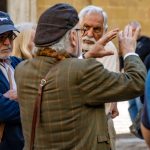
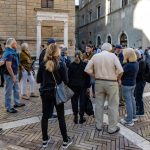
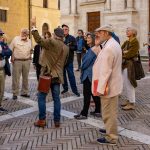
From Seaside to Pienza: Celebrating the Roots of New Urbanism

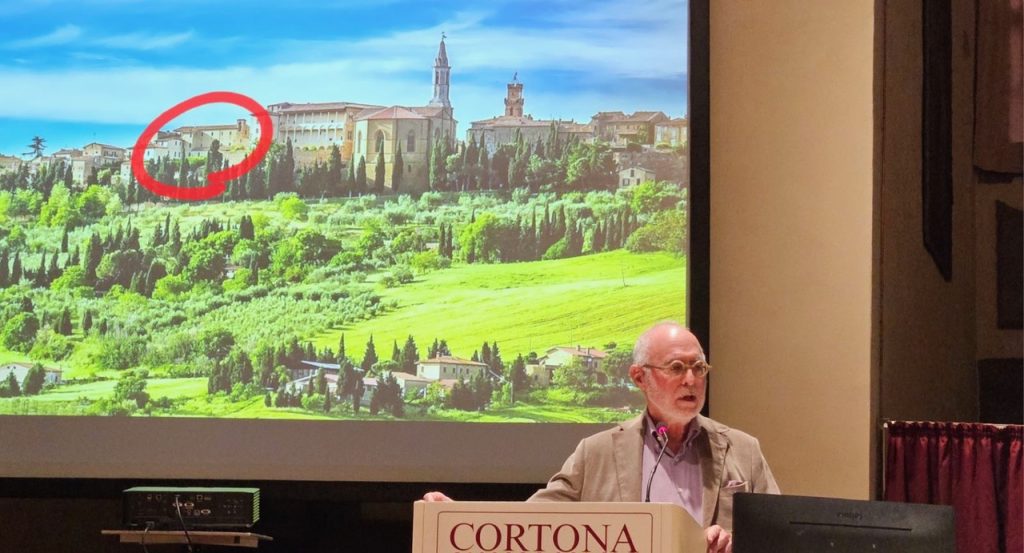
Last month, our founder, Robert Davis, spoke at the International Making Cities Livable (IMCL) conference in Cortona, Italy, sharing the history and future of Seaside with leaders from around the globe.

A highlight of this experience, coordinated by The Seaside Institute, was a day trip to Pienza, a Renaissance town that could be considered a “sister town” to Seaside. Pienza embodies the principles of traditional town planning that inspired Robert and Daryl’s vision. Instead of our Gulf Coast views, Pienza overlooks the breathtaking Tuscan valley—but its charm and thoughtful design resonate with our community in so many ways.

This unforgettable day included a talk by Professor David Mayernik, author of Timeless Cities, and meaningful exchanges with Pienza’s Town Architect Fausto Formichi and former Chief of Police Franco Volpi. Together, we continue to explore and share the enduring value of thoughtful community design.

Photos by Victor Dover.

The Seaside Institute’s intern shares a beginner's guide to New Urbanism

The Seaside Institute’s intern shares a beginner’s guide to New Urbanism

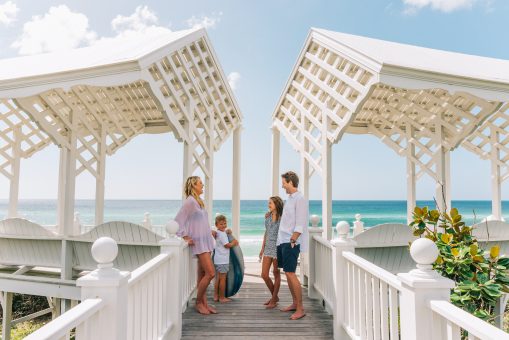
If you’ve spent time in Seaside, you’ve more than likely heard about New Urbanism. But you might not know exactly what that means. We’ve broken down some of the terms you’ll see here and how they’re defined, along with a history of how the town came to be.

A brief history:

Seaside was the invention of its town founders and planners with a vision to break out of American Suburbia. The founders saw suburbia as ruining the American landscape, creating communities only accessible by cars that segregated classes, alienating people from their neighbors. They also found that the suburbs were not environmentally sustainable. In the early 1980s, Robert and Daryl Davis created Seaside, a New Urbanist town, which looked to pre-automobile methods of city planning.

What caused American Suburbia

In the 1920s, a Supreme Court decision ruling set a precedent that created what we know as functional zoning. Functional zoning means that cities can create districts such as residential, commercial, industrial and more, emphasizing the power of private property over the public realm. This creates functionally dead zones, as the residential areas are empty in the daytime while the commercial areas are empty in the mornings and evenings. Vibrant neighborhoods are created by an even spread of people with different schedules and purposes throughout the day — that is, a mixed-use, multi-purpose district.

After World War II ended, the problem of functional zoning was made worse by the G.I. Bill, which made it easier for veterans to buy homes. These federally-insured mortgages only applied to new construction, not renovations on existing homes, which incentivized moving out of cities. As a result, cities became functionally dead and dangerous.

The end of World War II also saw wartime industry, like shipbuilding and aircraft construction, pivot into car production. Low taxes on gas helped the car industry expand, and new interstate highways were built for easier cross-country travel and military use. The expansion of roads created “suburban archipelagos,” towns which could not be navigated easily on foot.

What is New Urbanism

New Urbanism is a return to traditional town planning, in which neighborhoods have a diverse mix of people, uses and architecture, all designed with humans — not cars — in mind. With multi-use zoning on properties, neighborhoods have an even spread of people in the community all day long for different purposes, and diverse populations occupy the same spaces. The community is small, making it largely walkable and self-contained, with meaningful links to other towns and cities. Lastly, the architecture and landscape is designed on a human scale.

Seaside rethinks the importance of the car in daily life. The town is a 10-minute walk from end to end, and a five-minute walk from the town center, making daily needs easily accessible without a car. This is important because people without driver’s licenses no longer rely on the car — children can walk to school, grandparents can walk to the pharmacy, and any member of the household can run an errand. Note that the streets are narrow, making them more suitable for walking or biking rather than driving.

How New Urbanism focuses on outdoor spaces

Seaside also emphasizes the importance of public life over private life. The architectural code mandates small houses with front porches on small lots, which force people out of their homes to interact with other people. Rather than large private outdoor spaces, like backyards or gardens, Seaside has Central Square, Ruskin Place and public beach pavilions, which bring the community together in shared outdoor spaces. Seeing your community face to face, either at a Central Square movie night or passing by on the front porch, makes a town safer.

We also see a diverse mix of uses in the Seaside public spaces. In Central Square, four-story buildings are occupied by retail, groceries, restaurants and cafes on the first floor. The second story is rented out to office spaces, like architects and commercial developers. The upper stories are residential spaces, so a mix of age groups, families and incomes live in the community, making it more vibrant.

Lastly, Seaside is designed with a form-based architectural and zoning code, meaning that a property owner can build whatever they desire as long as it has key elements of the code, such as wood siding, a metal roof or a front porch. This allows for a variety that adheres to the regional vernacular — the architecture of Seaside looks like it belongs in its region.

Notice how often you truly have to get into your car in Seaside and consider the difference it makes in your daily life. If you have an hour lunch break, do you spend it running errands in your car? Or can you walk home, to a restaurant, out to meet friends, and enjoy your time? New Urbanism seeks to change the way people live, emphasizing quality of life over distance traveled.

Discover Seaside: The Seaside Institute Introduces Self-Guided Walking Tour

The Seaside Institute launches self-guided walking tour of Seaside

In celebration of Seaside’s 40 years, the Seaside Institute has created a self-guided walking tour of Seaside through Otocast, which includes more than 20 points of interests, along with narration from the renowned architects, designers and planners that built Seaside, the birthplace of New Urbanism.

Download Otocast Here

Points of interest include:

Airstream Row
The Chapel – Scott Merrill
The Chatham House – Walter Chatham
Coleman Beach Pavilion – David Coleman
The Court (formerly known as the Motor Court) – Scott Merrill
East Ruskin Beach Pavilion – Stuart Cohen & Anders Nereim
Holl Building
Krier House – Leon Krier
The Lyceum
Natchez Beach Pavilion – Steve Badanes
Natchez Park – Charles Warren
Odessa Beach Pavilion
Pensacola Beach Pavilion
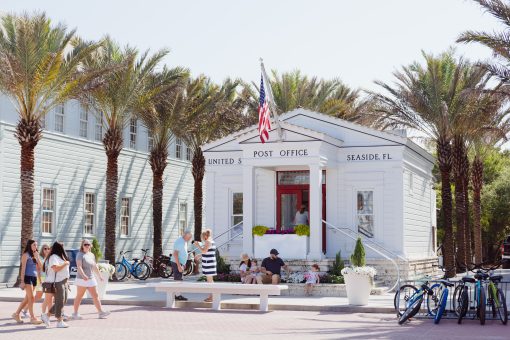
The Post Office – Robert Davis
Red House – Davis Red House first built and rental office – Robert Davis
Rose Walk
Ruskin Place – Alex Gorlin
West Ruskin Beach Pavilion – Michael McDonough
To begin enjoying the self-guided walking tour, download the Otocast on your smartphone app store from wherever you are and learn about Seaside and what went into the design of this iconic town. Enjoy while in Seaside or from wherever you are.

Partnership with Ascension

Living through the pandemic has heightened the need for more community healthcare outpatient services. Telehealth had not become widely adopted except in rural areas where acceptable bandwidth existed. Now, videoconferencing in multiple formats such as Facetime, Zoom, Skype, WebEx, and many others have become commonly used tools while the global population sheltered in place. Doctor consultations through these computer platforms are now accepted and even preferred by many for their convenience and reduction of contaminant exposure.

The Seaside Institute is proud to announce a new Lab Express from Ascension Sacred Heart. Initially, the Lab Express will offer blood draw or phlebotomy services. Walk-ins are welcome on the first and third Tuesdays of each month from 7 a.m. to noon. Expansion of the days and hours will be considered as demand increases.

“The Seaside Institute thanks Henry Stovall, Ascension Sacred Heart regional president, and Roger Hall, retired president of Ascension Sacred Heart Emerald Coast, along with Charles Henry, Ascension Sacred Heart Emerald Coast laboratory manager, for working with us on this program. We will continue to identify other opportunities to bring quality patient-centric care to South Walton. This extends to leading a healthier life through well-being and physical wellness,” said Victoria Lee, Seaside Institute Chairman.

The Lab Express will be located inside the Seaside Assembly Hall at 168 Smolian Circle in Santa Rosa Beach. Two complimentary reserved parking spaces are located directly in front of the Assembly Hall. Most major insurance providers are accepted. Patients are asked to confirm coverage with their insurance provider.

Reflections on Seaside

The Seaside Institute is offering the new Dhiru Thadani book: Reflections on Seaside through the Seaside Institute store. The sequel to the critically acclaimed Visions of Seaside (2013), Reflections on Seaside celebrates the fortieth anniversary of the town of Seaside, returning to the place that has inspired countless designers, architects, urban planners, and everyday citizens in the search for the ideal home. All purchases support the Institute and its mission. Institute members receive a 10-percent discount when they login to the portal before making their purchase.

About Seaside Institute

Join us on our journey to help people create great communities. For more information or tickets, please go to our website at seasideinstitute.org.

The Seaside Institute is a 501 c3 non-profit. Our mission is to Inspire livable communities. Through education, innovation, and engaging our community, we are working to improve the quality of life for families and individuals within Seaside, as well as nationally and globally, while at the same time creating an innovative design that not only enhances the beauty of our environment but, preserves it as well.

If you are interested in helping the Institute fulfill its mission contact us at: information@seasideinstitute.org, or call us at (850) 231-2421.

Become a Member:

Membership Does Have Its Perks

*Early registration for events hosted and produced by the Seaside Institute
*Reduced rates for select paid events
*For further information on our benefits visit our website at seasideinstitute.org

Donate:

We work with our mission and the greater good in mind. We don’t sell a product you can take home, we depend on your generous support of our mission. You can make a donation directly to the Institute, Sponsor, or choose to attend a paid event.

Volunteer:

As a small organization, we use volunteers to augment our staff, help us at events and work together in engaging the community in the mission of the Seaside Institute. All skill levels are needed and we are happy to train our new volunteers.

Internships:

The Seaside Institute provides continuous learning opportunities for college students seeking for-credit internships through projects that benefit the organization and help the student meet their objectives for learning and skill development.

Advocate:

Advocating for a mission is one of the easiest things one can do in support of an organization, especially when you are passionate about the mission. If you have a passion for education, a strong sense of community, and want to improve the quality of life for friends, family, co-workers, and acquaintances, working with the Seaside Institute is a terrific and convenient platform.

Stay Connected.

Follow @seasidefl on Instagram.